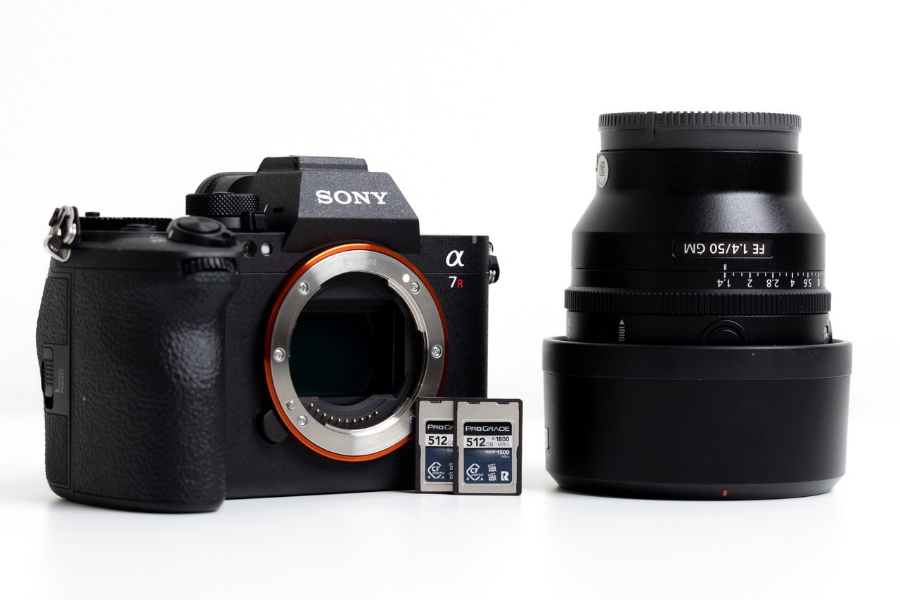
Mechanical, electronic, or electronic front-curtain?
Silent shooting can feel like an obvious upgrade. The camera becomes quieter, the burst rate climbs, and exceptionally fast shutter speeds appear in the menu.
Then a golf club bends across the frame. An LED-lit room develops dark stripes. The flash refuses to fire. None of these results make much sense if we think of the shutter as a simple door that opens and closes.
Every shutter controls how long light is recorded, but it does not always start and end that exposure across the whole sensor at once. Mechanical, electronic, and electronic front-curtain shutters manage that timing differently. Once you understand the sequence, working with each of them becomes much easier.
This article explains how different shutters work, when rolling shutter and banding appear, and which mode to use when.
One Shutter Speed, Two Measures of Time
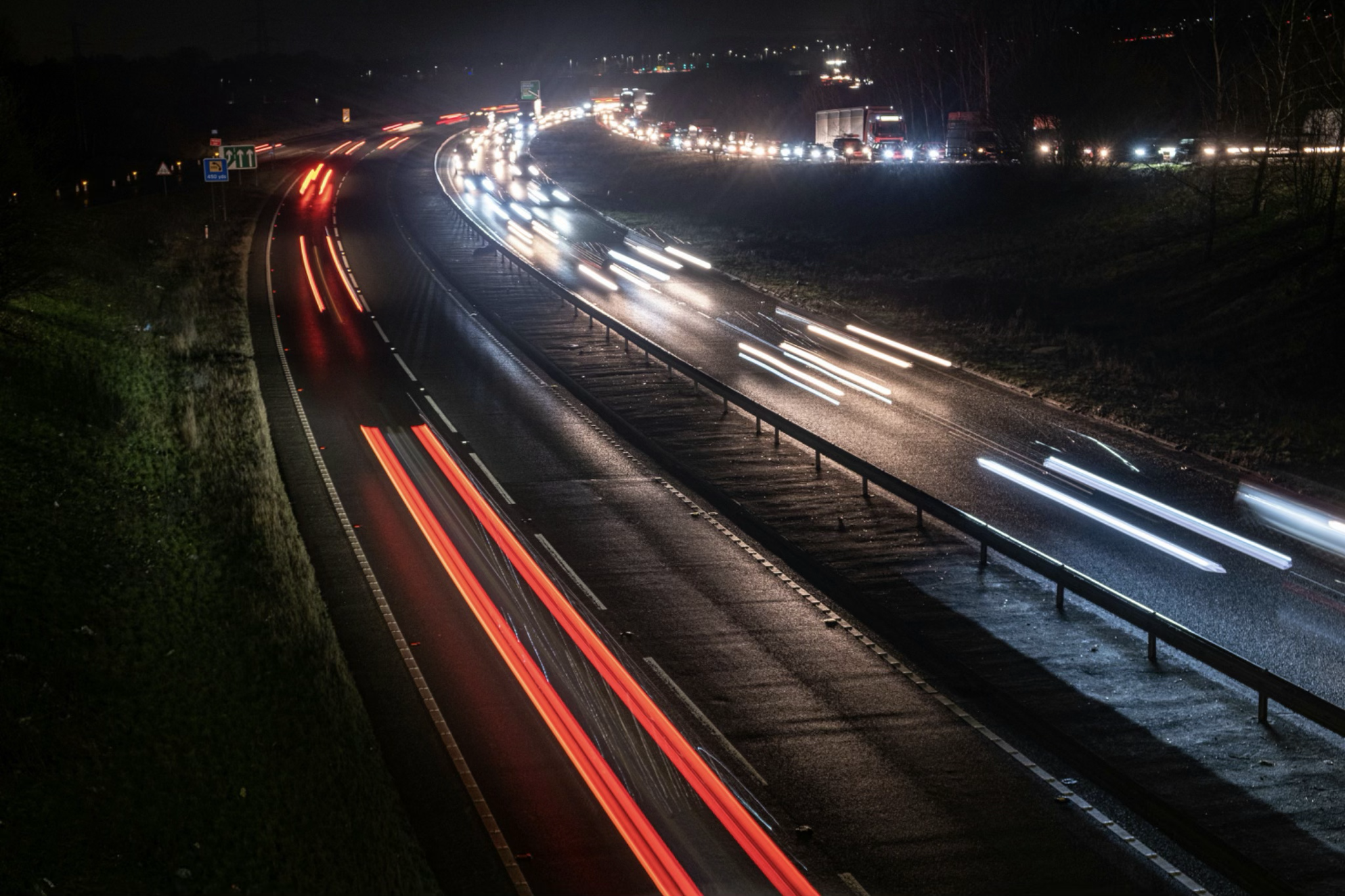
Long-exposure photograph of nighttime highway traffic, illustrating how a slow shutter speed captures moving headlights and taillights as continuous light trails, creating motion blur while stationary elements remain sharp.

Short-exposure photograph of nighttime traffic, illustrating how moving vehicles appear relatively sharp, with individual headlights clearly visible when captured using a fast shutter speed.
The shutter speed shown on the camera describes the exposure time for each part of the image. It does not necessarily describe how long the camera takes to move from the first part of the frame to the last.
Imagine an electronic shutter set to 1/8,000 second. Each row may collect light for 1/8,000 second. However, if the sensor takes 1/30 second to scan the full frame, it records the last row much later than the first. A moving subject can change position while the camera is still assembling the frame.
This distinction between exposure time and total scan time explains most of the unexpected differences between shutter modes. A fast shutter speed can freeze detail without making the entire frame simultaneous.
What a Mechanical Shutter Does
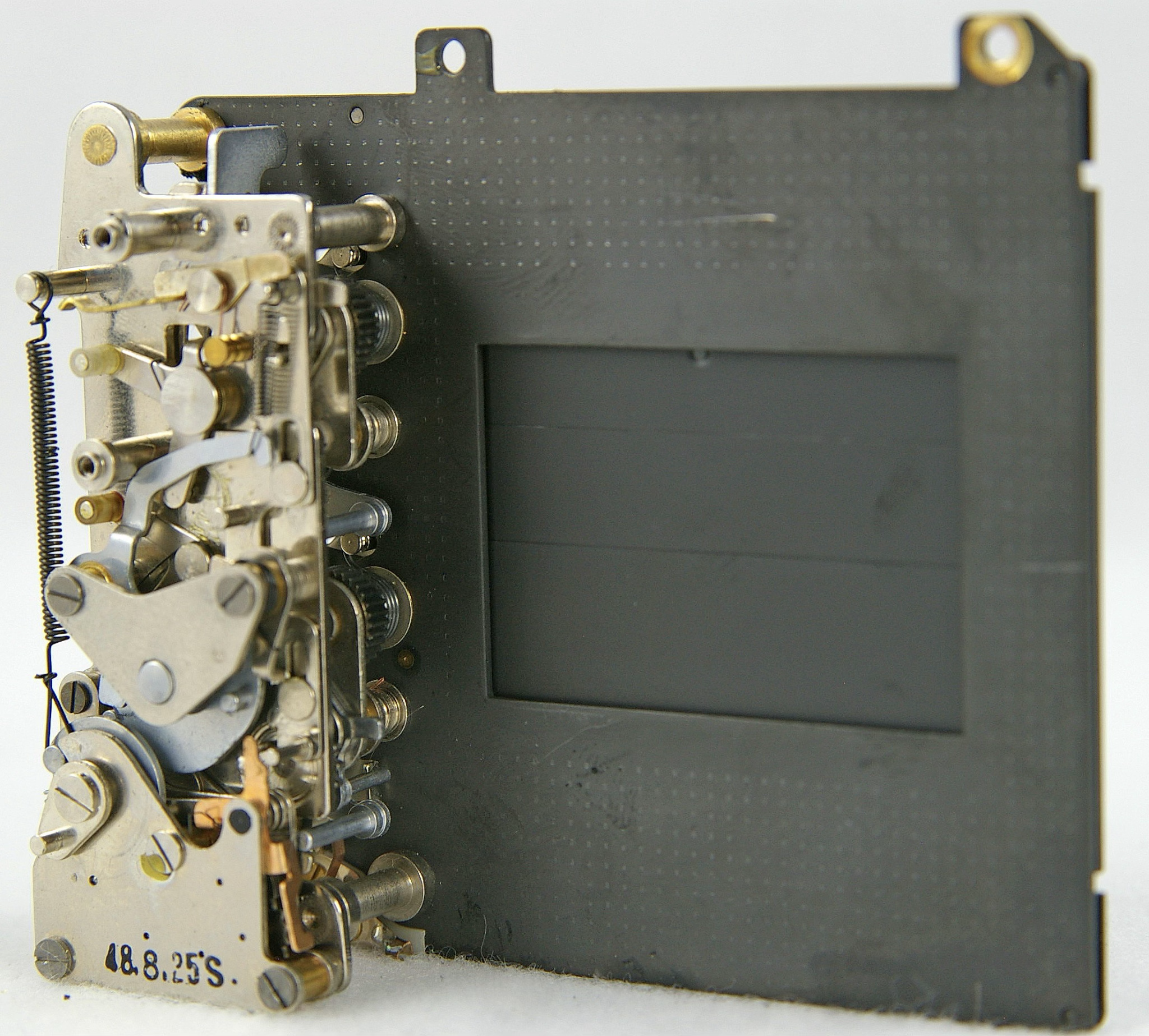
Mechanical focal-plane shutter mechanism showing the gears that control the movement of the shutter curtains.
Most interchangeable-lens cameras with a mechanical focal-plane shutter use two lightweight curtains positioned just in front of the sensor.
In a mirrorless camera, the shutter normally remains open for live view. In fully mechanical mode, the front curtain first closes to prepare the sensor, then opens to begin the exposure. After the selected time, the rear curtain follows to end it.
At moderate and slow shutter speeds, the first curtain has time to clear the sensor before the second curtain begins moving. For a brief period, the entire sensor is uncovered.
At faster shutter speeds, the second curtain starts chasing the first before the first has finished its journey. The two curtains form a narrow slit that travels across the sensor. Every part of the image still receives the selected exposure time, but different parts receive it at different moments.
A mechanical focal-plane shutter does not always capture the whole frame simultaneously either. Fast movement can distort the image, although curtain travel is usually quicker than the full-frame readout of a conventional electronic shutter. That shorter scan is one reason mechanical mode remains dependable for action on cameras with slower sensors.
Why Flash Sync Speed Exists
A conventional flash releases most of its light in a very short pulse. For that pulse to illuminate the complete frame, the sensor must be fully uncovered when the flash fires.
The fastest shutter speed at which this can happen is the camera’s flash sync speed, often around 1/200 or 1/250 second, although it varies by model. Above that speed, the moving slit would expose only part of the sensor during a single flash pulse, leaving a dark band across the rest of the image.
High-Speed Sync, or HSS, works around this with a rapid series of lower-powered pulses while the slit travels. It enables faster shutter speeds, but effective flash output drops because the light is spread over a longer period.
Some fast-readout electronic shutters can synchronize with flash, while many cameras disable flash completely in electronic mode. Global-shutter cameras can go further because they do not have a traveling exposure slit. These are model-specific capabilities, so the safe working rule is simple: check the camera and flash manuals before an important shoot.
How an Electronic Shutter Works
An electronic shutter does not cover the sensor. In a typical rolling-shutter CMOS sensor, rows of pixels are reset to begin collecting light and then read in sequence to end the exposure. The exact implementation varies, but the frame is effectively sampled line by line.
Removing the mechanical curtain sequence brings clear benefits. Electronic shooting can be silent, produce no shutter shock, add no cycles to the mechanical shutter count, and often unlocks the fastest continuous rates. It may also let you use wide apertures in bright light without an ND filter.
“Silent” describes the shutter, not necessarily the entire camera. Autofocus motors, aperture blades, and stabilization systems may still be audible, something worth checking at ceremonies, performances, and quiet sets.
None of this means electronic is automatically faster in every sense. A camera may offer 1/32,000-second exposures while still taking several milliseconds—or much longer—to scan from one edge of the frame to the other. The first number freezes motion within each row. The second determines how much the subject can move between rows.
Depending on the model, electronic mode may limit flash, long exposures, flicker reduction, ISO settings, RAW bit depth, or certain burst options. Those restrictions belong to the camera, not to every electronic shutter.
Why Sensor Readout Speed Matters
“Backside illuminated,” “stacked,” and “global shutter” describe different aspects of a sensor. They are not three steps on one universal speed scale.
A backside-illuminated, or BSI, design primarily changes how light reaches the photosites. It can improve light-gathering efficiency, but the BSI label alone does not reveal how quickly the sensor scans.
A stacked sensor places the pixel layer and much of the processing circuitry on separate layers. This can create room for parallel processing and, in some designs, high-speed memory close to the pixels. Readout can be much faster, but it still varies with the camera, resolution, crop mode, bit depth, and drive mode.
A global shutter changes the exposure sequence itself. All pixels begin and end together, with charge stored so the data can be read afterward. This removes the time offset that bends fast subjects. It does not mean every pixel’s data leaves the sensor at once, nor guarantee better performance by every other image-quality measure.
The Sony α9 III, for example, pairs a full-frame global shutter with bursts up to 120 fps and unusually fast flash sync with compatible units. Those capabilities come from its global shutter and should not be assumed for electronic shutters in general.
For rolling-shutter cameras, full-sensor scan time is the important specification, although manufacturers do not always publish it. Architecture provides clues, but results from the exact camera and capture mode tell you more than the sensor label alone.
Where Electronic Shutters Can Go Wrong
The two most common problems are movement distortion and banding from light that changes during the scan.
Rolling-Shutter Distortion
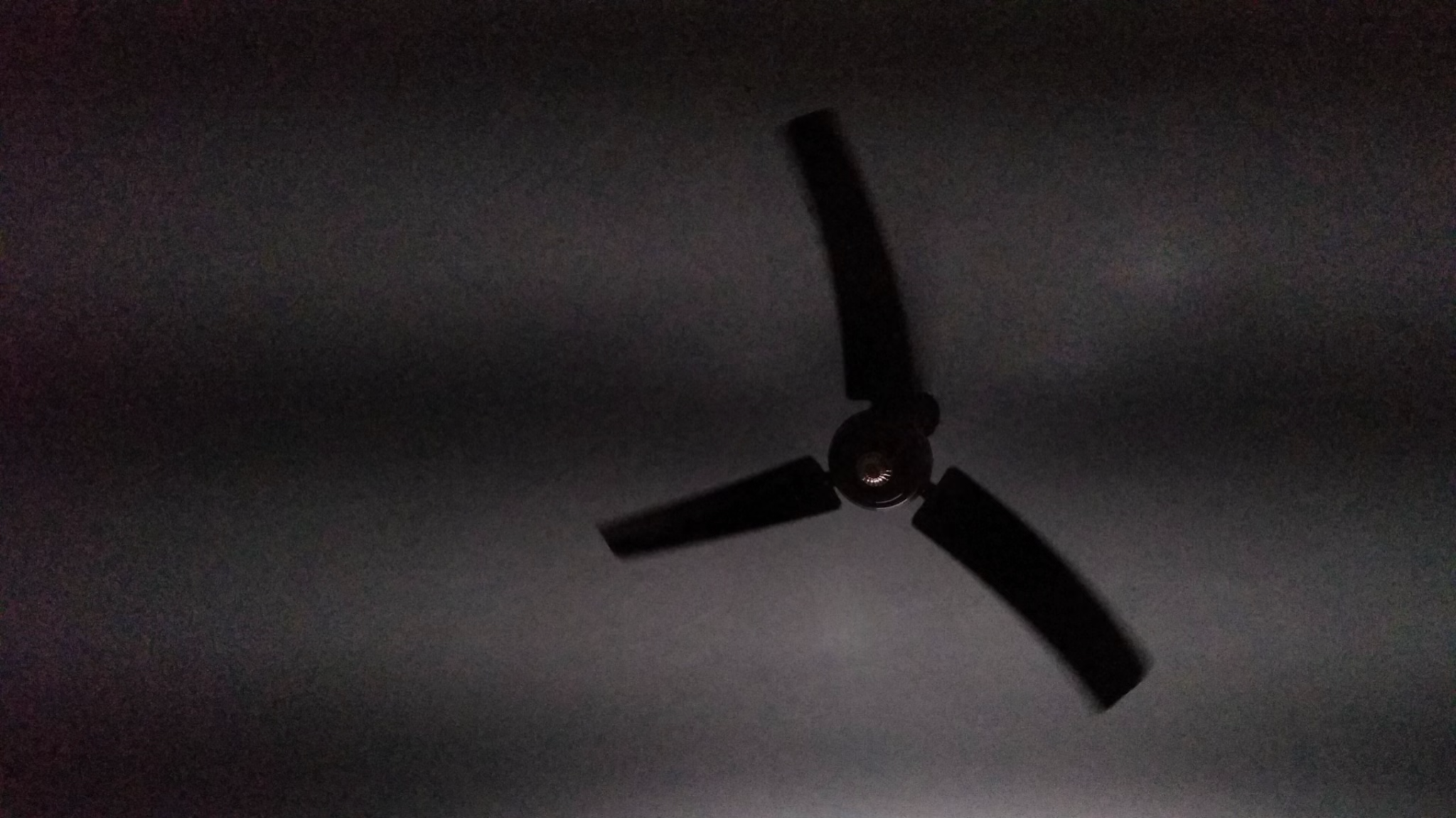
Rolling-shutter distortion causes the blades of a rotating fan to appear bent, as different parts of the image are captured at slightly different moments.
If a subject moves during a rolling scan, each row records it at a slightly different time. A mid-swing golf club can look bent. A propeller can curve. A fast car can appear stretched, while panning can make buildings and goalposts tilt.
The effect depends on movement across the frame and scan time, not just shutter speed. A quick pan shifts the whole scene between the first and last rows. Stabilization cannot turn a rolling scan into a simultaneous moment.
If straight lines bend, switch to a mechanical shutter or a faster electronic readout mode. A sufficiently fast stacked sensor may already perform as well as—or better than—the mechanical option. Test the body rather than assume based on the menu label.
Banding Under Artificial Light

Banding caused by a flickering LED light source interacting with a camera’s rolling shutter, producing alternating bright and dark bands across the image.
Many fluorescent lamps, LEDs, signs, scoreboards, and stage lights do not emit constant light. Their output rises and falls with the power supply or an electronic driver. The flicker may be invisible to us, yet the sensor can record a different brightness or color as each row is scanned.
This produces bands across the frame, uneven color, or partly illuminated frames. Mains frequency is often involved: 50 Hz regions commonly favor 1/50 or 1/100 second, while 60 Hz regions often favor 1/60 or 1/120. LEDs can pulse at other frequencies, so these are starting points rather than guarantees.
A mechanical shutter can show banding too, particularly at fast speeds when its slit crosses the frame. A slower electronic scan gives more time for light to change during capture.
Pro tip: Many cameras include anti-flicker timing or a variable shutter function for fine adjustment. If electronic shooting is essential, tune the speed while watching for bands, then take a test burst. Otherwise, mechanical mode is often the quickest fix. Another photographer’s flash can also appear as a bright strip if it fires midway through the scan.
Electronic Front-Curtain Shutter
Electronic front-curtain shutter, usually shortened to EFCS, combines the two systems. The camera begins the exposure electronically, without moving a physical front curtain, and ends it with the mechanical rear curtain.
That electronic start can reduce shutter lag, noise, and the slight blur caused by shutter shock. This helps with high-resolution bodies, long lenses, macro work, and tripod-mounted exposures where slight vibration can soften detail.
EFCS is not a universal best mode. At fast shutter speeds and wide apertures, the electronic start and mechanical end occur on different physical planes. Light can be clipped unevenly as the curtain passes, causing uneven exposure or truncated out-of-focus highlights on some camera-and-lens combinations.
Pro tip: There is no single cutoff that applies to every system. If you are shooting near maximum aperture at a fast shutter speed and the bokeh looks unusual, use the fully mechanical shutter. Some cameras handle this automatically when you select an appropriate shutter mode.
Why Do Photographers Prefer an Electronic Shutter? And Why Does Media Matter?
One reason photographers choose an electronic shutter is its higher burst rate. Modern flagship cameras with an electronic shutter can shoot up to 30, 60, or even 120 frames per second in uncompressed RAW. This can make a real difference in high-speed, high-stakes situations.
That said, generating 120 high-resolution RAW files second after second creates an immediate, massive data backlog in the camera’s internal buffer.
For example, if one RAW file is 45 MB, a 30-frame-per-second burst generates 1.35 GB of image data each second. The camera holds those frames in a high-speed internal buffer while writing them to the card.
When incoming data exceeds outgoing data, the buffer fills, and the camera eventually slows or pauses. A faster card cannot raise the advertised frame rate, but higher sustained write speed sure can extend the burst duration and shorten recovery.
TheProGrade Digital memory card lineup includes CFexpress Type A and CFexpress Type B memory cards with sustained write speeds of 1,450 MB/s and 1,500 MB/s, respectively.
These cards ensure the buffer clears nearly instantaneously, preventing the camera from locking up during a critical sports or wildlife action sequence.
Paired with a corresponding ProGrade Digital USB4 workflow reader, capable of handling data traffic up to 5 GB/s, helps ensure the vast volume of RAW images you just captured moves equally fast from card to drive or computer and is immediately ready for post-production.
High-speed media and fast readers do not correct rolling shutter, prevent banding, or change flash sync. However, they determine how well the rest of the capture pipeline handles the volume of files created by fast shooting.
Which Shutter Mode Should You Use?
There is no single setting that is safest for every subject. A practical starting point looks like this:
| Shutter mode | Best suited to | Main trade-offs |
| Mechanical | Fast action on slower-readout cameras, flash, and difficult artificial light | Noise, vibration, maximum burst rate, and shutter wear |
| Electronic | Quiet environments, high-speed bursts, very fast shutter speeds, and cameras with fast sensor readout | Rolling distortion, flicker, flash support, and mode-specific image-quality limits |
| Electronic front-curtain | General shooting where lower vibration and shorter shutter lag matter | Fast shutter speeds with wide apertures, uneven exposure, and bokeh shape |
Pro tip: Before relying on a mode for paid work, test it under the conditions that matter. Pan past a vertical object. Photograph the venue lighting through a range of shutter speeds. Confirm that the flash fires. Then shoot a full burst with your intended RAW settings and time the recovery.
These checks reveal more than a specification sheet because they test the complete system: subject movement, sensor scan, light source, file format, buffer, and card.
Final Words
Mechanical and electronic shutters are not old and new versions of the same switch. They move exposure across a sensor differently, and each leaves a signature when the subject or light changes faster than the frame can be recorded.
A mechanical shutter is often safer for flash, unpredictable LEDs, and fast action on cameras with slower readout. An electronic shutter is invaluable when silence, high frame rates, or vibration-free capture matters, as long as the sensor can scan the scene cleanly. EFCS offers a useful compromise until fast shutter speeds and wide apertures expose its limitations.
Choose by subject movement, light, and flash; then confirm that the buffer and memory card can sustain the burst you need.