Sony Alpha and Cinema Line cameras are built for demanding work. They are used on productions where missed frames, interrupted takes, and slow recovery times have no place in the workflow.
To deliver that level of performance, the camera needs more than a capable sensor and processor. It also needs media that can keep up with the amount of data being captured, processed, and moved.
In this article, we’ll look at how CFexpress Type A memory cards help Sony shooters unlock higher-end recording modes, longer bursts, faster recovery times, and a smoother path from camera to post-production.
The Technical Edge: CFexpress Type A vs. SD UHS-II
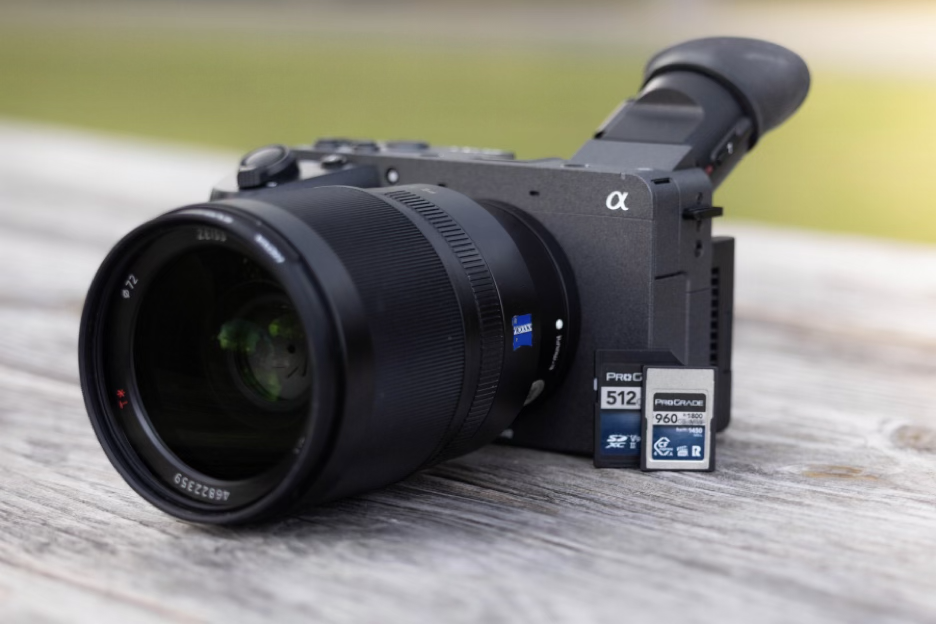
Many Sony Alpha and Cinema Line cameras use hybrid card slots that accept both SD UHS-II and CFexpress Type A. That gives shooters flexibility, but it also makes media choice more important. The two formats may fit into the same slot, but they are built for different performance levels.
SD UHS-II remains a strong choice for a wide range of photo and video workflows. It is fast, widely compatible, and practical for many professional shooting situations.
But when the camera is pushed to higher bitrates, faster frame rates, or long continuous bursts, CFexpress Type A becomes a necessity. Not only to give the system more headroom, but to unlock the camera’s full performance range.
The difference starts with the architecture. SD UHS-II cards operate within the limits of the SD interface, maxing out around 300 MB/s. Meanwhile, professional-grade CFexpress Type A cards use PCIe Gen4 NVMe technology, making them closer to a compact SSD than a traditional memory card. This allows the card to move data more efficiently and sustain higher write speeds under demanding use.
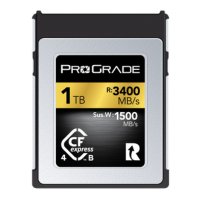
For example, ProGrade Digital CFexpress Type A cards are designed to sustain write speeds of 800 MB/s on 480 GB models and 1,450 MB/s on 960 GB models. That sustained performance is what gives Sony shooters the confidence to utilize the camera’s most demanding settings.
Unlocking Advanced Video: The VPG Standard
Not every fast-looking card is built for demanding video. In a market where memory cards are often promoted by peak read and write speeds, it can be hard to know which cards can actually sustain the performance required for high-bitrate recording. That is the problem VPG was created to solve.
Video Performance Guarantee Explained
VPG, short for Video Performance Guarantee, is a memory card certification system created by the CompactFlash Association. It verifies a card’s minimum sustained write speed for video recording and provides a shared performance standard for camera manufacturers, card makers, and shooters.
The VPG rating is easy to spot and read. It appears as a number inside a small clapperboard icon on the card. Number 200 inside the clapper means the card is certified to sustain at least 200 MB/s write speed.
Why VPG Matters for Sony Camera Users
Advanced Sony video modes generate a steady stream of data that the card must keep writing without falling below the camera’s requirements. If the card cannot keep up, recording can stop. So, to ensure data integrity, the camera must verify that the card meets the required standard before unlocking data-intensive shooting modes.
For Sony shooters, VPG200 is a must for unlocking high-bitrate All-Intra and S&Q recording modes. The camera needs a memory card with a required certification.
VPG vs. Sustained Write Speed
VPG is the certification to look for, but it does not always reflect the card’s full performance.
VPG ratings top out at 400 MB/s, but professional-grade cards can sustain write speeds well above that.
That is why ProGrade Digital prints sustained write speed directly on the card, denoted as Sus. W. and followed by a number.
Many memory cards highlight peak read or write speeds, which are useful for understanding maximum performance, but do not tell the full story for long video recording or burst photography. Sus. W gives Sony shooters a clearer number: the write speed the card is actually designed to maintain continuously.
So while VPG confirms the card meets the official certification requirement, Sus. W marking indicates sustained performance beyond the baseline.
For example, ProGrade Digital Iridium CFexpress Type A cards carry an official VPG200 rating, meaning they have been certified to handle a minimum of 200 MB/s of incoming data required by Sony, but their actual sustained write speeds reach up to 1,450 MB/s.
The simple rule: look for the VPG clapperboard icon to confirm certification and compatibility, then check the Sus. W number to understand the card’s real sustained write performance.
High-Speed Photography: Clearing the Buffer for Burst Shooting
In burst photography, the camera captures multiple images in rapid succession while the shutter button is held down. The success of that operation depends on how quickly the camera can move those image files to the memory card.
As the camera shoots, it writes files to the card and uses its internal buffer as temporary storage. The faster the card can accept data, the faster the buffer clears. If the buffer fills, the camera slows down, limits the burst, or takes longer to recover before it can shoot at full speed again.
In sports, action, wildlife, and event photography, having a “locked” camera as the moment unfolds can make the difference between capturing the sequence and missing it.
That is why professional-grade CFexpress Type A matters for high-speed photography. Pairing ProGrade Digital CFexpress Type A cards with compatible Sony cameras allows for near-infinite continuous shooting in compressed or uncompressed RAW.
Buffer Recovery in Real-World Scenario: SD vs CFexpress Type A
This is where time-to-clear becomes the most useful comparison. Using the Sony A1 as an example, an uncompressed RAW file can be around 106 MB. A consumer-grade SD card, guaranteed to sustain 30 MB/s, would clear less than one of those RAW files per second from the buffer. Meanwhile, a ProGrade Digital Iridium CFexpress Type A card designed to sustain 1,450 MB/s can clear roughly 13 RAW files per second at that file size.
That difference compounds quickly. A 100-image uncompressed RAW burst would represent about 10.6 GB of data.
- A consumer-grade V30 SD card, clearing that data at 30 MB/s, would take nearly 6 minutes.
- A V90 SDXC card, writing at 90 MB/s, improves that clear time to about 2 minutes.
- A CFexpress Type A card designed to sustain 1,450 MB/s write speed would take only around 7 seconds.
That is why professional-grade CFexpress Type A does not only extend the burst, but keeps the camera ready to shoot at full speed at all times.
Optimizing Sony Cameras for the Professional Workflow
High-performance Sony workflows create large files quickly. 4K 120p, All-Intra recording, long interviews, event coverage, and high-speed RAW bursts can fill cards fast, and once the shoot is over, that data has to be moved before backup, editing, or delivery can begin.
This is where media choice continues to matter. CFexpress Type A does not only help the camera write data faster during capture. It also shortens the path into post-production when paired with a fast reader, fast cable, and fast destination drive. Without that, the bottleneck simply moves from the camera to the offload station.
For Sony shooters, the memory card reader choice also matters.
First, speed matters. If the reader (or a cable) becomes the bottleneck, the speed gained in-camera is lost at the desk. That is why USB 4.0 readers are recommended for CFexpress Type A users.
Second, type matters. For Sony shooters, the workflow is often mixed. A production may use CFexpress Type A for the most demanding recording modes, while SD UHS-II is used for backup, secondary recording, stills, or lighter video work. That flexibility is useful, but it also means both card types need to be handled efficiently after the shoot. That is why dual-slot readers capable of handling both formats simultaneously tend to be best for mixed-card workflows.
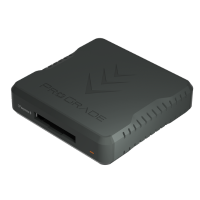
ProGrade Digital CFexpress Type A and SDXC UHS-II Dual-Slot Card Reader | USB 4.0 was created specifically to speed up professional mixed-card workflows. It allows both Sony media types to move through the same offload process, helping copy, verify, back up, and organize files without switching readers or breaking the chain between capture and post.
These readers come with a certified USB 4.0 cable and have an integrated heat sink and built in fan for better cooling during continuous offloads.
Why ProGrade Digital CFexpress Type A?
ProGrade Digital CFexpress Type A cards are built for Sony shooters who need certified performance, clear specifications, and field-tested reliability in one card.
In addition to the already discussed VPG certification and industry-leading sustained write speeds, there are several other reasons to choose ProGrade Digital CFexpress Type A cards for Sony workflows.
Most importantly, they are built for professional use outside controlled environments. ProGrade Digital CFexpress Type A cards are tested for temperature, shock, vibration, and X-ray exposure, and their metal enclosure supports durability and heat dissipation during demanding shoots.
On top of that, instead of a standard 1-year warranty, ProGrade Digital CFexpress Type A cards are backed by a 3-year warranty, reflecting the build quality.
And last but not least, ProGrade Digital CFexpress Type A cards are also Refresh Pro™ enabled. This gives users a free way to monitor and maintain card health over time.
Pro Tip for Sony Users
Getting the right card is only part of the workflow. Sony shooters should also make sure the camera is set to use that card correctly.
In the Record Media Settings menu, choose the CFexpress Type A slot for the most demanding video modes, high-speed stills, or any workflow where buffer clearing and sustained write speed matter most. If you are using both card types, CFexpress Type A is usually the better choice for primary recording, while SD UHS-II can be used for backup, secondary recording, or lighter capture.
Final Words: Maximize Sony Camera Performance with CFexpress Type A
Sony cameras are built to perform, but their performance depends on the media they use. CFexpress Type A gives compatible Alpha and Cinema Line cameras the speed needed for demanding video, long bursts, and smoother offloads.
For Sony shooters, the right card does more than store files. It helps keep the workflow moving.
Browse ProGrade Digital CFexpress Type A Cards for Sony Cameras →