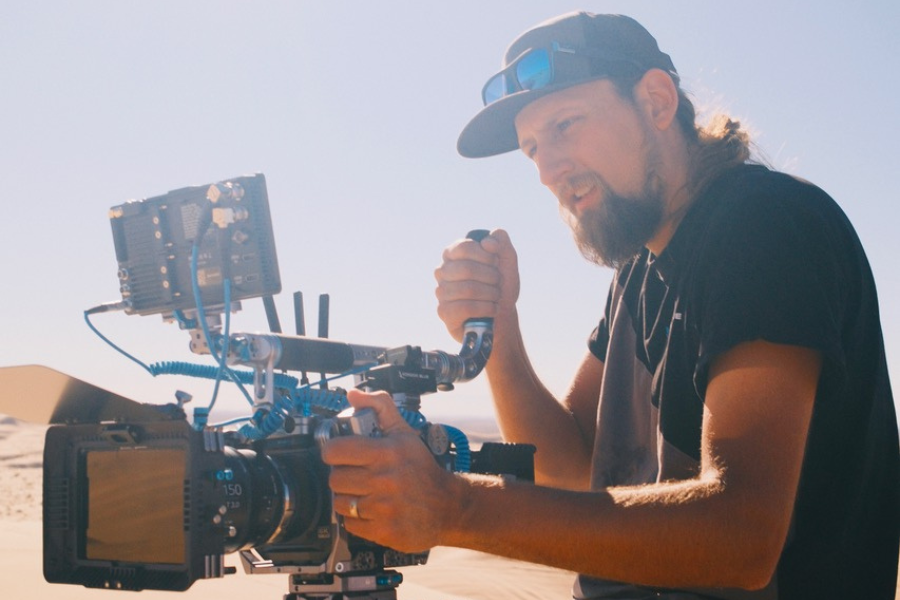
For more than two decades, Lukas Colombo has built a reputation as a filmmaker who blends technical mastery with emotional storytelling. Raised between Santiago, Chile and the United States, he went from shooting on Super 16mm as a teenager to directing award-winning commercial campaigns, docu-series, and music videos. Today, he’s the founder of Kondor Blue, one of the most respected brands in the camera accessories world. His background in cinematography, directing, problem-solving on set, and building creative teams has shaped the gear trusted by filmmakers worldwide.
Recently, we sat down with Lukas to explore the path that took him from crafting homemade camera rigs to collaborating with some of the biggest names in the industry. He walked us through the long nights, creative breakthroughs, and values that shaped Kondor Blue into the brand filmmakers trust today. What follows is a closer look at that journey.
“I’ve always said, I’m my own customer. If something solved a problem for me, I knew it would help a lot of other filmmakers too.” – Lukas Colombo
The Interview:
You’re running a successful gear accessories business, however, you started your career in music videos and commercials. How did those early experiences shape your approach to storytelling and cinematography?
You know, early on music videos, short films and commercials were definitely my training ground. They move fast. You can get the same size crew as a feature film, but the turnaround is so much quicker, which makes them really rewarding. You see the final product almost right away. That speed forces you to be disciplined and intentional with every shot.
Almost twenty years ago, as a teenager I was shooting on super 16mm, so every frame was expensive. That taught me early on how to plan things out, and I’ve carried that with me ever since. The prep work (the vision and the schedule) that’s what gives you the freedom to improvise once you’re on set. When you know exactly what you need to get, you can actually relax and be creative in the moment.
Music videos and commercials also sharpened my storytelling instincts. You only have a minute, maybe three, to make people feel something. Nowadays, it’s more like 15-30 seconds. That kind of pressure trains you to communicate visually with precision because every frame matters. And honestly, all of that translated directly into how I approach branding and marketing for Kondor Blue. After spending years helping artists and companies build their visual identity, creating a brand of my own felt like second nature.
What inspired you to transition from working behind the camera to founding your own business in the camera accessories industry?
You know, I’ve always been the kind of person who loves solving problems on set. In the early days, I didn’t have the budget for fancy gear, so I’d hit the hardware store and build my own. I made dollies, sliders, and little rigs. Some of them weighed a ton, but they worked. Other filmmakers would see them and ask me to build one for them. So that maker instinct has always been there.
At the same time, I’ve had an entrepreneurial streak since I was a kid growing up in Santiago, Chile where I used to sell popsicles to my dad’s co-workers or run the family garage sales as young as 8yr old. I started my own production company when I was about 20, and that’s how I supported my family for years, just directing, shooting, and running my business. It was a grind, but it taught me that success is really about execution. Everyone has ideas, but very few actually bring them to life.
Then around 2018, everything lined up perfectly. I was working closely with Blackmagic on the launch of the Pocket Cinema Camera 4K, and I had early access to the camera before it was released. The moment I held it, I could see all the accessories it needed and none of them existed yet. I knew that camera was going to be a hit, so I dove in headfirst, working long nights designing and producing our first Kondor Blue products in time for its release.
I’d been experimenting before that; sourcing materials, testing supply chains, even dabbling in e-commerce after taking a course with my mom. But the Pocket 4K launch was the spark. It combined my filmmaking experience, my entrepreneurial drive, and my love for solving real problems for creatives. That’s when Kondor Blue officially took off.
How did your personal experiences as a filmmaker influence the development of Kondor Blue’s first products?
You know, that’s really the heart of Kondor Blue’s success. I’ve always been, first and foremost, a filmmaker. I’m still actively directing and shooting projects to this day; ad campaigns, indie features, doc series. And recently, I directed a music video for an amazing artist named Mergui, who’s huge in Israel and now breaking into the U.S. market, with Shane Hurlbut, ASC as my Director of Photography. That shoot was a blast, and it reminded me why I fell in love with this craft in the first place. Being on set keeps me grounded in what filmmakers actually need.
When I started Kondor Blue, I was designing products I personally needed. The very first ones were for cameras I was using at the time, the Blackmagic Pocket Cinema 4K and the URSA Mini. I’ve always said, I’m my own customer. If something solved a problem for me, I knew it would help a lot of other filmmakers too, from working pros to students just getting started.
Every early product came straight from my own hands-on experience. Some of the first were camera handles and grips with built-in start/stop control and quick-release systems to speed up rigging. I’d been on so many shoots where we wasted time screwing parts together while the client stood there watching. That frustration pushed me to design smarter, faster solutions.
And cables, those were a big one. I’d broken so many SDI and HDMI cables on set, or found out a power cable was dead right before a take. It’s crazy how one cheap cable can bring an entire production to a halt. So I started designing cables that were stronger, braided, reinforced, and made in the exact lengths filmmakers actually needed. Some of the connectors for the new cameras didn’t even exist yet, so I sourced and built them myself.
That’s how it all began. With me creating the gear I wished existed. Even now, everything we design starts with real on-set experience and feedback from other filmmakers. I still trust that instinct today. If I need it, chances are thousands of others do too.
What are some unique challenges you’ve faced as both a filmmaker and a founder in the camera accessories industry?
One of the biggest challenges, both as a filmmaker and as a founder, has always been capital. Whether you’re trying to finance a movie or build a company, finding the resources to bring your vision to life is tough. I didn’t come from a wealthy background. I grew up in South America with missionary parents. My dad’s Chilean, my mom’s American. And while we were always taken care of, we didn’t have extra cash lying around. So I’ve had to build everything from the ground up.
That challenge hasn’t gone away. Kondor Blue’s growth has been incredible year over year, but keeping up with demand takes a lot of strategy and partnership. We’ve been blessed with amazing partners who believe in what we’re doing, but we’re always looking for like-minded investors and collaborators who share our vision and want to help us expand globally. That’s where most of my focus goes these days: scaling smart while protecting the quality and experience that got us here.
Another challenge (or maybe more of a realization) is how similar filmmaking and entrepreneurship actually are. When you produce a film, you’re basically launching a startup. You’re forming an LLC, hiring a team, managing budgets, logistics, creative, marketing, all under tight deadlines. It’s business and art colliding at full speed. And just like in filmmaking, running a company means constant problem-solving. Things will go wrong; that’s a guarantee. The job is to stay calm, adapt fast, and find creative solutions.
At the end of the day, both filmmaking and running a company come down to teamwork, vision, and persistence. You build something from nothing, you lead people through chaos, and you watch it all come to life. That’s what makes both worlds so exciting.
You’ve had collaborations and sponsorships with major brands like Apple, Sony, and Canon. How have these relationships impacted Kondor Blue’s growth?
For me, one of the biggest things in life, and in business, is relationships. We’re created to connect deeply with others, and I’ve always believed in building authentic, long-term relationships based on adding value. My rule of thumb has always been to give more than you receive. If you’ve been blessed with resources, connections, or skills, use them to help others. That’s how real partnerships are built.
Many of Kondor Blue’s relationships with top brands actually started long before Kondor Blue existed. Back when I was working as a cinematographer and director, creating launch films and content for those companies. Over time, those relationships deepened because Kondor Blue products directly enhance the value of their gear. Our accessories don’t compete with their cameras, they elevate them.
We hear it all the time: someone will say, “I bought the camera because I loved the Kondor Blue cage,” or “I chose this camera because of your solutions for it”, that tells me we’re helping these brands succeed too. It’s truly a rising-tide-lifts-all-ships kind of relationship.
What’s been really exciting is when these major companies reach out directly and ask us to design products for their specific camera lines. That level of trust is huge, and it comes from years of consistency: doing what we say we’ll do, never cutting corners, and always putting quality first.
These collaborations have also opened up opportunities to co-promote and cross-market, which is powerful. Instead of each brand spending big on separate campaigns, we combine forces, share audiences, and tell a more complete story of how filmmakers actually use gear in the real world with cameras, cages, and accessories all working together.
At the end of the day, it’s all about people. Treating others the way you want to be treated has opened doors I could never have forced open. These partnerships have been game-changing not just for Kondor Blue’s growth, but for me personally. I’ve built friendships, learned from some of the best minds in the industry, and been invited into rooms where the future of filmmaking is being shaped. It’s incredibly rewarding and deeply motivating.
Kondor Blue is known for its lifetime warranty and exceptional customer service. Why are these values important to you?
When I first realized Kondor Blue could become something real, a company that could make a difference, I wanted it to be the solution to all the frustrations I had as a filmmaker and customer. Back then, I was using gear from other brands, and honestly, the experience was awful. The warranties were terrible, the companies didn’t stand behind their products, and the customer service was practically nonexistent. If you were lucky enough to get someone on the phone, they usually didn’t know the product, and more than once I was told to “just buy a new one.”
So when I started Kondor Blue, I knew exactly what I wanted to do differently. I wanted people to feel supported not just as customers, but as fellow filmmakers. My goal was for our customer service to feel like calling a filmmaking friend: someone who understands what it’s like to be on set under pressure and genuinely wants to help you succeed. That’s why every member of our support team either comes from a creative background or has real on-set experience.
I’ve personally helped customers troubleshoot issues on set, even with competitors’ products. I’ve literally downloaded their manuals just to walk someone through a fix because, to me, that’s what customer service should be: caring about people, not just transactions. When you treat people right, you build trust, and that’s what creates customers for life.
The lifetime warranty came from that same philosophy. Ideally, you’ll never need it because we engineer everything to last. But if something does go wrong, we stand behind it, no questions asked. Even cables. If one fails, we replace it for free. It’s about giving filmmakers peace of mind, knowing their investment is protected and that someone actually cares.
At the end of the day, it’s pretty simple: treat others the way you want to be treated. That’s the foundation of our customer experience, and it’s been at the core of Kondor Blue since day one.
Giving back is a core value for Kondor Blue. Why did you choose World Vision as your current charity partner, and what does this partnership mean to you personally?
Giving back has always been a core value for me, personally and for Kondor Blue. I believe that when you’re blessed, you have a responsibility to bless others. Success doesn’t mean much if it doesn’t create positive ripple effects beyond your own circle.
My family has supported World Vision for many years now, so when it came time to choose a charity partner for Kondor Blue, it was a natural fit. My wife and I have four kids, and with their own money they chose to sponsor a child in need through World Vision. Every night we pray for that child and talk about what life might be like where they live. It’s been really meaningful for our family to give financially and to build empathy in our children. They’ve donated their own birthday or Christmas money to help kids in need, which makes me incredibly proud as a dad.
Partnering with World Vision through Kondor Blue has allowed us to expand that impact in a bigger way. But it’s not the only organization we support. We’ve also given to Adventures of the Heart, which is an amazing ministry that helps men come alive the way God intended, with freedom, purpose, joy, and courage. It has personally changed my life and absolutely I love what they’re doing and how it aligns with our belief in living fully and authentically.
Ultimately, giving isn’t about checking a box, it’s about faith and gratitude. Even in times when it feels like we can’t afford to give, that’s often when we should give the most. Time and again, I’ve seen God show up and provide in those moments. Everything good in my life and in Kondor Blue comes from Him, and giving back is just one way of acknowledging that truth. At the end of the day, nothing matters more than our relationships with each other and with our Creator.
As a founder, what’s been the most rewarding moment for you since starting Kondor Blue?
You know, I don’t think I can point to one single moment and say, “That was it.” The truth is, the most rewarding part of building Kondor Blue has been the family that’s come together around this brand.
From our warehouse crew to our marketing and creative teams, from customer support to logistics, sales, and admin, every person plays such a vital role. Watching them grow has been incredible. I’ve seen team members get married, start families, become parents for the first time, and find real joy in their work. Seeing them come in every day excited to collaborate with their friends is the most rewarding part for me, hands down.
We’ve had some big milestones along the way. Awards, major trade show booths, collaborations with huge brands and creators. And those are all amazing. But none of it compares to the day-to-day fulfillment of working alongside people who genuinely love what they do and care about each other. That’s what makes Kondor Blue special. It’s not just a company; it’s a family.
Looking ahead, what’s your vision for both Kondor Blue and the film industry as a whole? What can we expect next from you and your team?
We’re living in exciting (and crazy) times. The technology in our industry is evolving faster than ever. It feels like there’s a new camera every few months, and we’re constantly racing to design the right accessories for them. That alone keeps us busy. But beyond keeping up, my focus is on staying ahead, anticipating where filmmaking is going next.
Right now, we’re seeing a massive wave of creators using the camera that’s already in their pocket; their phones. That’s why we’ve been developing a whole new ecosystem for mobile filmmaking, something that brings Kondor Blue quality and design thinking to a space that’s exploding with potential. At the same time, there are other new product categories and verticals we’ve been wanting to enter for years. Areas where customers have literally asked, “When is Kondor Blue going to make something for this?” You’ll start to see some of those coming to life soon.
AI is another big factor reshaping the landscape. I’ve already started using AI tools in my own directing work for things like storyboarding, previsualization, and animatics. And it’s incredible how far the technology has come. I don’t think AI will ever replace humans in storytelling; emotion and empathy are uniquely human traits. But I do see AI transforming certain sectors, like stock footage or B-roll production, while also creating entirely new kinds of creative jobs. It’s like the early days of the internet. Disruptive, yes, but full of opportunity if you approach it with the right mindset.
As for Kondor Blue, the future is all about innovation, collaboration, and community. We’ve got some really exciting products and partnerships on the roadmap; collaborations with some of the world’s best filmmakers and creators. I’m excited for what’s ahead in 2026 and beyond: new tools, new relationships, and new opportunities to empower storytellers everywhere.
Any other tips or highlights from your experience you’d like to share?
If I had to leave one final thought, especially for anyone out there dreaming of becoming a founder, building a company, or creating something of their own, it’s this: find what you’re truly passionate about. Identify the things that light you up, the subjects or problems you could talk about for hours without getting bored. Then figure out how to bring value to that space. Figure out how to build solutions, how to make a difference, maybe even how to turn it into a business.
Because here’s the truth: building something from scratch takes everything you’ve got. It takes sweat, late nights, sacrifice, and perseverance. And if you’re not deeply passionate about what you’re doing, it’s going to be hard to stick it out when things get tough. And they will get tough. But if you love it, if you’re genuinely excited about what you’re building, then even the hard days become part of a journey you wouldn’t trade for anything.
That’s been my experience with Kondor Blue. It’s hard work, but it’s meaningful work. And that makes all the difference.
Final Thoughts
Lukas Colombo’s journey is a reminder that great products, and great companies, are built from equal parts passion, problem-solving, and purpose. Whether he’s directing a motion picture, sketching out a new accessory design, or helping a filmmaker troubleshoot gear on set, Lukas shows up with the same commitment to creativity and community.
His story proves that when you combine craftsmanship with compassion, innovation with integrity, you build something that genuinely supports the people behind the camera. And as Kondor Blue continues to grow, it’s clear Lukas and his team are just getting started. We look forward to seeing what comes next.